Creator Return Audit
See the trials your creators really drive. Even from the viewers who never clicked.
So your link tracking gives the credit to nobody. And your best creator can look like your worst.
A creator posts about your app. Thousands of people see it. Almost none tap the link.
Views countedThey remember the name, open the App Store and type it in. No link, no code.
Credit lostIt lands in "organic". Creator Return finds it again in your daily numbers.
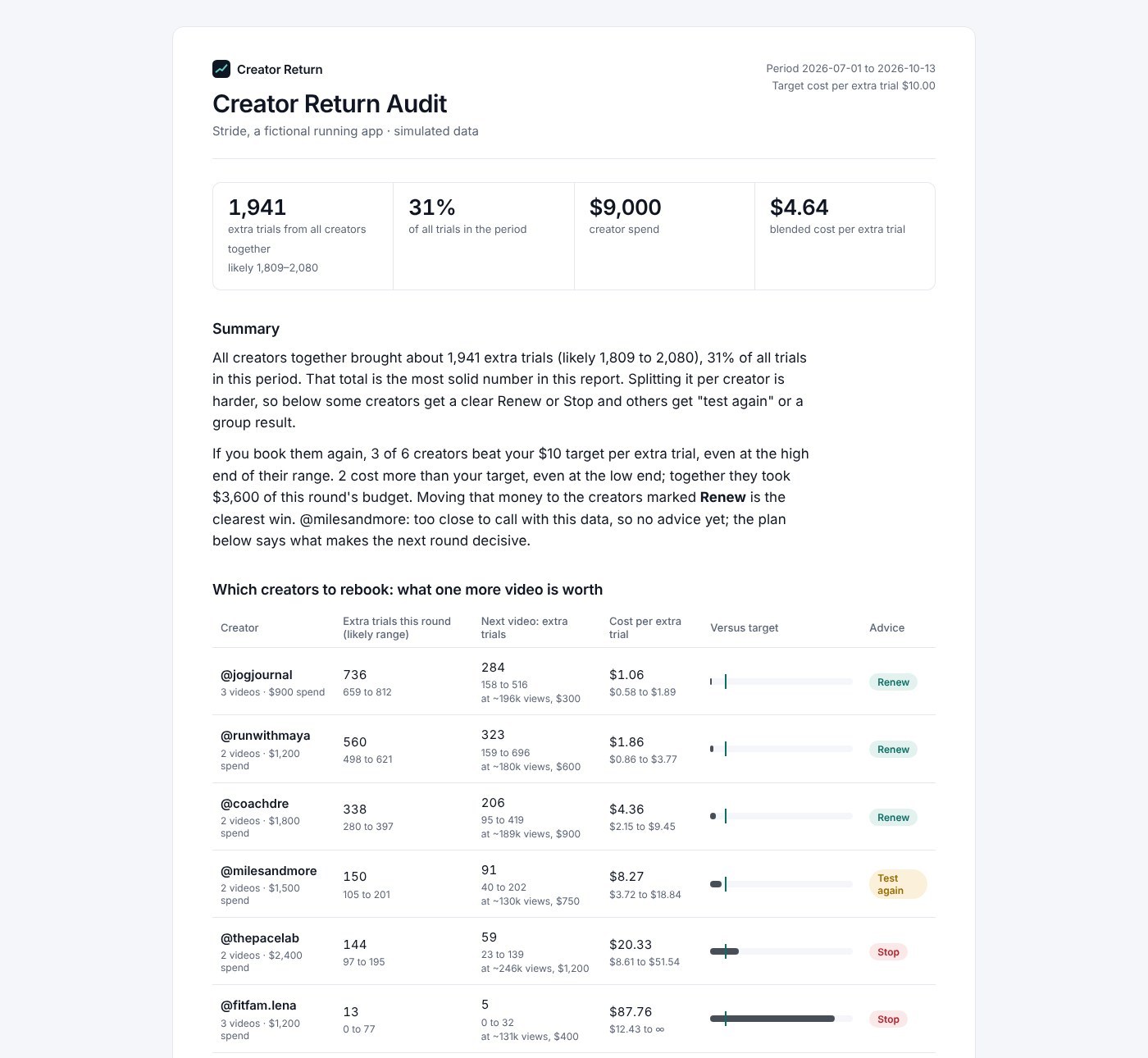
Credit foundThis is what you get back, shown with the sample data.
Cost per extra trial if you book one more video.
31% of all trials came from creators, clicks or not.
Spent on creators who cost more than the $10 target, even at the low end of their range.
Every number comes with a likely range. Too close to call means test again, not a guess.
Only daily totals, no user data. Your files are deleted 30 days after your report.
Figures from the sample report on simulated data for a fictional running app.
Daily trial starts for 60 to 120 days from RevenueCat, Superwall or App Store Connect, saved as trials.csv.
Link, post date, views and what you paid for each creator video, in videos.csv. Tell us if you ran paid ads (daily spend per channel), and any launches or price changes in the period.
First a free data check. If your data can answer the question, you get the report within 5 business days: cost per extra trial per creator with a likely range, a Renew or Stop call where the data allows one, and a plan for your next round.
Creator Return Audit
about $175 · invoiced in euros · card payment
One audit, including a plan that makes your next creator round measurable. You only pay after a free check shows your data can answer the question.
Or email hidde@creatorreturn.com. You'll hear back within one business day.
About 4 to 5 creator videos over at least 60 days, with two weeks of data before the first video. It works best when videos are big next to your daily trials, for example 100k views on an app with about 20 trials a day. The free data check tells you before you pay.
Those count only the people who tap or type them. The audit counts everyone the model can tie to a creator's views, so you can put both side by side.
It's a regression on your own daily data, not a controlled experiment. We tested it on simulated apps where the true effect of each creator is known: the true value fell inside the likely range about 85% of the time, and a Renew or Stop call was wrong for at most 3 in 100 creators. That caution has a price: depending on the app, a quarter to over half of creators get "test again" or a group result instead of a call. The free data check tells you how many of yours can get a call before you pay.
We also tried to fool it with six tricky cases, such as one creator warming up viewers for another, press caused by a creator, and late tracking. It gave no wrong call; it reported a group or asked a question instead. We control for the launches, ads and price changes you tell us about.
Then the data can't tell them apart, and the report says so. You get their joint effect as a group instead of a split we can't back up. If that matters, we suggest a posting schedule that makes the next round measurable.
Then we need your daily ad spend per channel. Ads in the same weeks as your creators would otherwise look like creator trials. With the spend, the model gives those trials to the ads. Without an answer about ads, no creator gets a Renew call.
You send daily totals only, no user data and no account access. Files are used for your report only and deleted 30 days after delivery. Happy to sign your NDA. Details in the privacy notice.
Not yet. Creator Return is new, which is why the data check is free and you only pay when your data can answer the question.
Hidde, an econometrics student in the final year of a BSc, working from Denmark and setting up a business in the Netherlands. The method is the same kind of time-series analysis large brands use in marketing mix models, sized for one app.